Go Inward. Together.
The Retreat
There are things we can understand about ourselves intellectually.
And then there are things we have to experience.
We can know our patterns and still repeat them. Understand where they came from and still find ourselves caught inside them.
The Retreat invites us to step outside our ordinary lives, slow down, and experience ourselves in a new way.
Is this for me?
The Retreat is for people who find themselves at a threshold.
Perhaps something in your life is changing — or you know something needs to. You may be moving through a transition, questioning a path that once made sense, or feeling the pull toward a life that feels more deeply aligned with who you are.
You don't need to have it figured out.
But you do need to be willing to do the work.
To question what you know.
To encounter what you may have avoided.
To stay curious about what might emerge.
You may come with a clear question — or simply with the feeling that something is ready to change.
Artful Weaving - Four Ways In
My approach to The Retreat has been shaped by my years as a teacher of the Hoffman Process, meditation and yoga practice, theatrical and experiential work, and more than a decade of exploring altered states of consciousness.
Of everything I’ve encountered, I return again and again to four ways of exploring. The Retreat weaves them together in service of something deeper than any one practice can offer alone.
We begin with what is here—experiencing it, listening to what it has to show us, and opening to what we cannot yet see. We land by bringing what we discover back into our lives.
01 — EXPERIENCE
What happens when I enter it?
Inspired by psychodrama, Gestalt, and IFS, we use enactment and movement to bring what we are exploring to life.
We might visit a moment from our lives, embody a familiar pattern, give voice to something that could not be spoken at the time, or try on a way of being that once felt impossible.
By stepping into these moments rather than only talking about them, we may discover feelings, perspectives, and possibilities that weren’t available to us before. We listen to what arises in the body, what emerges as we step into the experience, and what is reflected back through the group.

02 — REFLECTION
What happens when I listen to it?
Experience opens the door. Reflection asks us to stay with what we find there.
We slow down to notice what is still moving within us and what may be waiting beneath the noise.
Rather than immediately trying to explain, solve, or change what we find, we stay curious.
Over time, we begin to recognize what feels true — and what may be asking for our attention.
03 — EXPANSION
What opens when I step beyond the familiar?
Reflection helps us listen more deeply. Expansion invites us beyond the familiar.
Through visualization, ritual, music, and practices that open us to altered states of consciousness and transpersonal experience, we loosen our habitual ways of seeing and make space for something new to emerge.
In these expanded states, we may encounter what is difficult to access through our ordinary ways of knowing: a deeper intuition, a sense of connection to something larger than ourselves, or even a glimpse of the sacred within.
We don’t need to know what we will find. The invitation is simply to become available to what we could not see before.
04 — INTEGRATION
How do I live what I have discovered?
Deep work can open something within us. Integration is how we carry it into our relationships, work, and everyday lives.
After the retreat, we reconnect through one-on-one coaching to revisit what surfaced and explore what it might mean in practice — through choices, conversations, and changes in how we live.
The retreat doesn’t end when you leave. That’s where the real work begins.
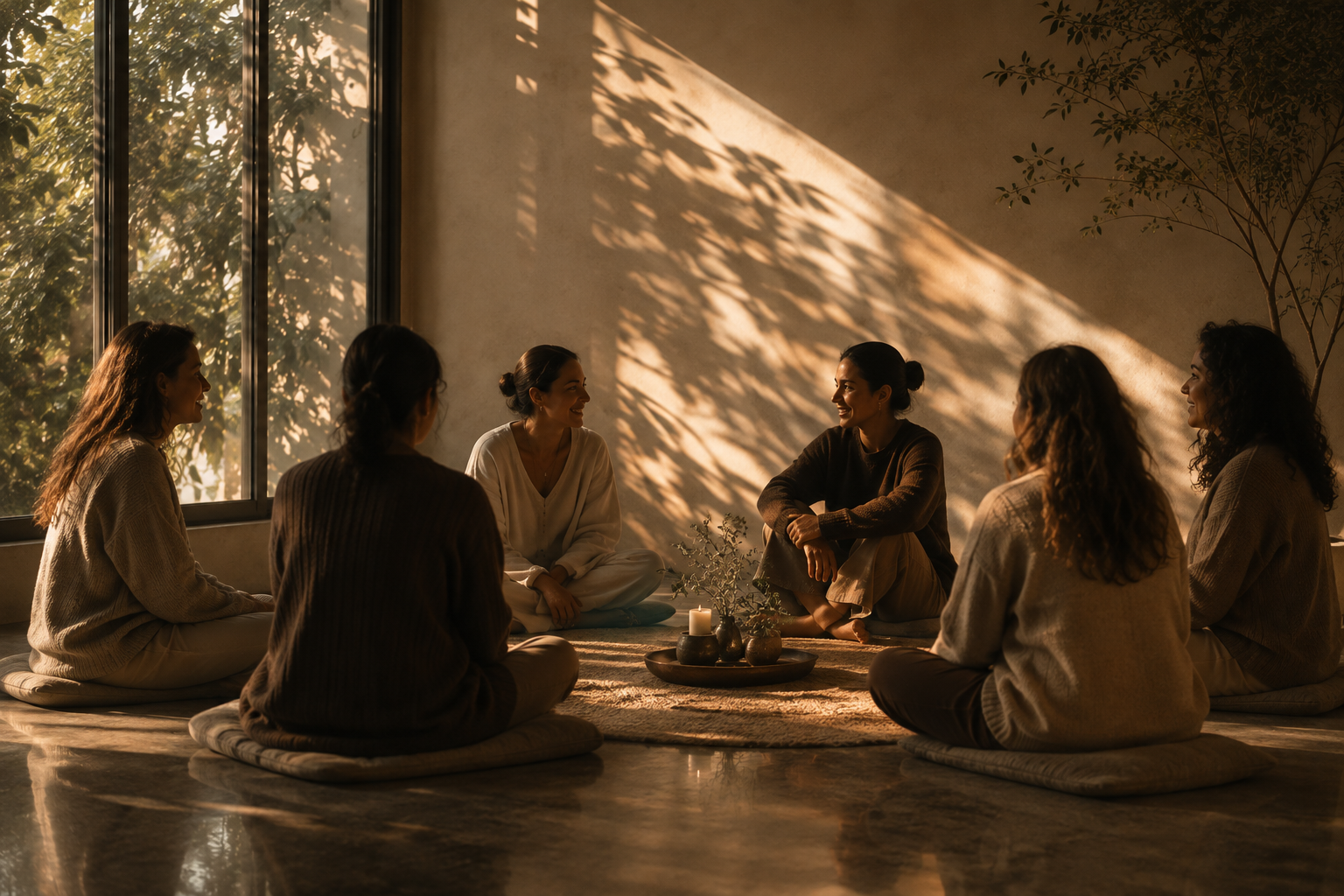
And then, there is the group.
Early in my coaching career, I preferred working one-on-one. I believed greater depth required greater privacy.
After facilitating more than thirty group retreats, I changed my mind. I began to see that a group reveals things that simply don't emerge one-on-one.
Our patterns do not only live inside us. They appear between us.
The ways we seek approval, disappear, protect ourselves, take up space, hold back, caretake, or long to belong inevitably begin to reveal themselves. A group can make these patterns visible remarkably quickly. And what becomes visible can become workable.
Many of our deepest wounds were formed in relationship. I believe some of our deepest healing happens there too.
There is also something powerful about being witnessed.
One person tells the truth and someone else realizes, I’m not the only one. Someone takes a risk and gives another person permission to do the same. What begins as one person’s work can move through the whole room.
And then there is something harder to name: the field itself.
As trust deepens, the group becomes more than a collection of individuals. We begin to notice what is happening between us—what is spoken, what remains unspoken, and what seems to be asking for our collective attention.
Sometimes someone else’s experience illuminates something in us before we even know we are looking for it.
The group is not simply where the work happens. The group is part of the work.
What People Are Saying
Aerin helped our leadership team move from leading primarily through individual strength, control, and numbers to leading through connection, trust, and collective awareness.
By creating the space to step out of our roles and truly see ourselves and one another, we surfaced dynamics that are almost impossible to see in the pace of everyday work—and changed how we listen, challenge, decide, and take responsibility together.
The impact she had on us reaches far beyond the retreat itself. In a $1B organization doubling every three years and serving more than 150,000 students across Latin America, the quality of our connection determines the quality of our decisions, culture, and ultimately the impact we create. The retreat reminded us that our responsibility is not simply to manage the numbers, but to become the kind of leadership system capable of holding the scale, complexity, and human impact of what we are building.
- Patricia Barrios Verand, CEO of Continental International Education
Aerin is one of those gifted people who makes you feel truly seen - perhaps more clearly than you see yourself while somehow making you feel completely safe at the same time.
She brings such genuine love and compassion to her work. She is deeply wise and razor-sharp, but there’s not an ounce of ego about her. She has a quiet strength and presence that’s hard to put into words - still waters run very deep with Aerin. You just trust her! She had a profound impact on me.
— Andrew White, former president of Quark Expeditions
Aerin holds space in a way that creates real calm, curiosity and an unfolding of openness in others. The combination of her dedicated training paired with her natural gifts create a level of safety which allows those around her to truly go deep.
- Kae Burke, co-founder of House of Yes

The Retreat is offered twice a year. The next retreat is scheduled for January 2027 in Northern California. If this speaks to you, fill out the form below, and I'll follow up with more information.